


 Contact me
 Learn about me & my mission
July 27th, 2022 | Two Times Charm: Back to Dharamshala.

This text was fully written by a human.
At some point during my travels, I noticed that interesting people are not scattered through the world at random, but rather, there are sites of collective intelligence where people form hiveminds — clusters of builders of all backgrounds who stimulate each other: founders, creatives, artists, scientists. Spending time in a place like that is like walking into a serendipity machine.
Dharamshala turned out to be one of these special sites where one and one equals more than two. I visited last year for the first time thanks to my friend, Atal Agarwal, and I fell in love with this place right away.
Do You Have a Personal Strategy for Traveling?
On Sites of Collective Intelligence.
There are many ways to travel the world.
Some people travel for extreme sports.
Others travel following their ancestors, or for spiritual reasons.
Some just feel hungry for experience and wish to see as many cultures or countries as possible before one day they pass away. Yes, you can’t see it all, but at least you can see a nice selection of places.
Some people just let go and challenge themselves: expose themselves to randomness and danger, hoping to find their true self.
To some people, traveling is the basic instinct — they spend the rest of their daily lives working just to get back on track whenever they can afford it.
And to some, traveling is an escapism. They live what Mark Manson would call “an aesthetic life”: they sample new experiences year after year after year, and see it as progress while, in fact, all they do is just avoid any commitment (a commitment to a place, in this case).
I think in the past, I didn’t have a strategy at all; I was just plain curious for the most part… and I did practice escapism at times.
In my twenties, I spent two months in the Andes all by myself and barely talking to anyone. I definitely didn’t find my true self up there.
Some other time, I went with befriended Buddhist monks in the South of South Korea to visit local temples, just to find out that monks drink, party, and go dirty just like anyone else (or worse). I certainly didn’t find my true self up there either.
Zanzibar turned out to be a ghetto for rich people locked in a row of five-star hotels by the ocean, and slums everywhere else.
Hawaii looked like a postcard, but I didn’t really feel like I touched the local culture at all.
New York was a never-ending glittering banner show.
And so on and so forth. Traveling was certainly interesting, but it wasn’t life-changing by any means.
And I have never really had transcendental experiences from travel.
Eventually, I found an interesting pattern worth exploring, though:
I realized that whenever I prioritize going with people first over going with landscapes, I win on it: I come back from travel richer, healthier, and happier than on the day of departure.
Moreover, I noticed that interesting people are not scattered through the world at random, but rather, there are sites of collective intelligence where people form hiveminds — clusters of builders of all backgrounds who stimulate each other: founders, creatives, artists, scientists. Spending time in a place like that is like walking into a serendipity machine.
Dharamshala turned out to be one of these special sites where one and one equals more than two. I visited last year for the first time thanks to my friend, Atal Agarwal, and I fell in love with this place right away.


For the Second Time Around.
During my first visit, my Indian friends tried to persuade me to visit other tourist landmarks in their beautiful country, such as Kerala, Kashmir, Goa, Rishikesh, and whatnot. But I thought to myself that I was lucky enough to find my sweet spot: a place with great climate, landscapes, entertainment, people, nature, and literally anything I could need. Yoga, meditations, sauna, ecstatic dance — it’s all here, within walking distance.
And all these hustlers! Geniuses hidden in hotel lobbies. People who build stuff and go to market with it, without ever hoping for an investment or any other help whatsoever.
And that’s not without a reason. There is no middle class in India — Indian boys and girls know that if they don’t actively seek their opportunities in today’s economy, they will age and die in poverty. And they are on their own. There are no investors roaming around with pockets full of money in here.
So, instead of pitching to investors, local founders pitch straight to clients. Extraverted or not, they have no choice: they need to step out of their comfort zone and just do it. What a great inspiration to a bootstrapper!
There is some particular beauty to visiting a place for the second time: you feel more like a local this time around and can pay more attention to detail — quite as if you were watching a movie for a second time. Or, if you loaded your favorite video game — since you know the scenery, you can focus on just playing.
When I arrived back in Dharamshala, I caught myself remembering all the streets of Bhagsu, McLeod Ganj, and Dharamkot by heart. I could literally close my eyes and walk down the streets. I recalled the buildings, the streets, and the landscapes with an almost photographic memory.
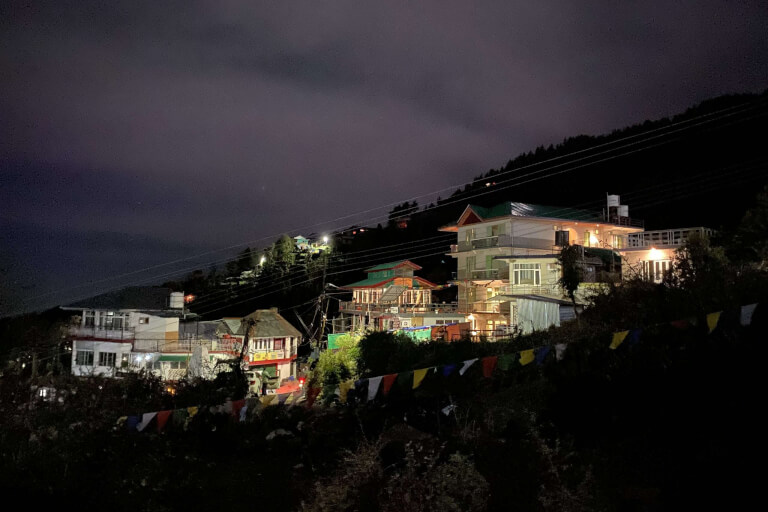
This time around, I additionally explored and memorized the whole map of Upper Dharamkot (which is steep but stunning — especially at night).
And there is something special in arriving in a place where you can just leave a cab, walk into your hotel, drop your backpack to the ground, and “go out” — namely, just go down the street and hear “Hi Natalia!” from every corner.
I met all my local friends again: the owner of my hotel, Shrikanth, a local Polish restaurant owner, Marta, a local master of Ayurvedic massage, Karvan, the local coffee artist, Sunny…
And I didn’t really have to put any effort into arranging my entertainment. My hotel was positioned perfectly between McLeod Ganj, the headquarters of the Dalai Lama, and Dharamkot, the local party place. I could visit Tushita Center for guided meditation in the mornings, go shopping and chat with travelers from all around the world in the local coffee shops in the afternoon, join ecstatic dance parties in the evening, and go hiking to Triund or visit the sauna and spa at Dakini House in McLeod Ganj on the weekends.
Not to mention that my own hotel was full of interesting people checking in and out, many of them being digital nomads — you couldn’t feel bored even on a rainy day.
Easy.
I was also happy to see that neither inflation nor shrinkflation came to Dharamshala—everything cost exactly the same as the previous year. I couldn’t believe this place isn’t getting invaded by tourists. What a gem!
Smarter with the diet but not with the weather.
I need to add that this time around, I was smarter about my diet. I managed to avoid that Great Diarrhea entirely (the one that had been tormenting me for the whole three weeks last year).
I achieved this by eating four bananas a day — two in the morning and two in the evening. You see, bananas have pectin; it’s this element that, apparently, helps with digestion.
At the same time though, I learned a painful lesson about the climate and the weather in here. Namely, the real tourist season starts in April, while March is still a gamble — even if it’s the end of March.
Since the previous year I experienced beautiful weather in the second half of March, I chose to jump back here. But, that wasn’t the best choice this time around. The weather was moody, to say the least, and since there is no central heating and I’m cold-sensitive, it cost me some pain.
“Next time I come back in April, even if that means I need to pay more,” I thought to myself.




My Relationship with God, Myself, Time, Money, and Nature.
Just as the year before, I came here for a while to work on my mind, and especially the parts of me that do not relate to other people — especially my intuitive mind.
You see, to follow your intuition in life, you need to have deep trust in yourself, but also in your relationship with the Universe, trusting that you read the signs the right way, and that reality will bend to meet your wishes.
How can you even get to the level of mastery in anything, starting from nothing — especially in the economy we have today? You’ll need to trust in your gut and hope for a good outcome right off the bat.
If you, say, want to be a great educator, your room will be empty at first. Then, your first student will join. And the second one. And the third.
You will only fill the room when you show enough enthusiasm and endurance in the first place, and deliver great work before you ever get noticed.
And you need to keep your head high and stay confident no matter how much time it takes. You need to get this trust and attitude from elsewhere; you won’t get it from people.
It’s a paradox: to gain people’s respect, you need to first detach your sense of mastery from other people’s opinion, and you only let yourself get judged in front of gods, nature, and yourself.
And so I continued working on myself.


The Hotel Life.
The social life at my hotel, on the other hand, was really vivid. We played board games with housemates, and we pulled off a movie night, playing everyone’s favorites: the movies with the one and only Shah Rukh Khan.
If you are not Indian, you might not have heard of him, but Shah Rukh Khan is like a God in India. On screen, he appears so smug… There is more Tom Cruise in Shah Rukh than Tom Cruise in Tom Cruise. Films with Shah Rukh Khan are more predictable than porn, utterly self-aware and self-deprecating, and eclectic in style — all shifting the tune from action to drama to slapstick comedy at random moments. If you put on a movie with Shah Rukh, you know you are up for grotesque and cringe. But trust me, you want it and need it more than you might think.
Our hotel’s social life revolved around the balcony, where people came to share and confess over wine (watch out: Indian wines are truly disgusting!) and cigarettes. I also had a few private, deep conversations on that iconic balcony. Spoiler: dilemmas of young Indians don’t differ much from dilemmas of young Europeans or Americans. We could connect and relate pretty easily.


What I Noticed the Second Time Here.
I think the fact that this time around, I was on my way back from a tai chi course in the mountains of Wudang, China, made a huge difference. Practicing tai chi for a week cleaned my mind and made me more attentive, and so I started noticing things here that I couldn’t see before.
For instance, I noticed that here in India, you should go shopping first thing in the morning. Why? Because the locals believe it’s better to give a discount to their first client and sell cheap, just to “open that money chakra.” They trust that once money starts flowing, it doesn’t stop, so it’s better to help the first client of the day make the right decision at any cost. I’m serious: go shopping in the morning and you will get a discount in every single store.
I also tried guided meditation at Tushita Center every morning, and finally realized why it didn’t work for me — not a bit. Compared to tai chi (which is, essentially, meditation through movement), it’s extremely static. Since you need to follow the teacher’s instructions, guided meditation stimulates your mind rather than your body. As master Gu has told me, I’m too much in my mind and too little in my body. No wonder I cannot focus.
I tried hard every morning and failed miserably every time. But I still did it, as it was a nice experience to take a morning walk uphill through the woods and in the morning spring sunshine, and then practice in a hall full of young, hopeful, smiling people (mostly looking like Western students).
I also went to do ecstatic dancing again — and I even made friends with the local DJ, the Bhaktas. He was really talented, and I thought to myself he would be competitive in the top clubs of Berlin or Amsterdam… and yet, he chose to live here, respect.
The Second Visit to His Holiness the Dalai Lama.
I also couldn’t help myself but to go visit the Dalai Lama for the second time. Since he was still offering meet-and-greets in his temple, it was a no-brainer. Dalai Lama was 91 (and close to 92) at this point, and you never know how many springs he has left. I wanted to catch the day.
I felt that this time around, his staff was keeping him even more guarded than before, and there was even less time to interact — just seconds.
He looked me in the eyes while I held his hands, and he seemed tired, distant, and sad. He looked at me, but I was wondering if he was even present. I think he must be exhausted by this never-ending public service ever since he was a little boy. And for many decades, service in exile.
What was surprising to me, though, was that I didn’t really experience much emotion this time around. “What’s happening, Nat?” — I asked myself. “You can’t just get used to seeing the Dalai Lama and treat it like a choir!”
Perhaps I’m getting more stoic with age; who knows. And perhaps, your brain can habituate to everything — even to meetings with His Holiness. That’s not good.
Did I Get Used to the Dalai Lama?
I also asked myself this serious question: Did I get used to visiting the Dalai Lama?
Now that I had the chance to meet him for the second time ever, I put it on the agenda, and just went ot the Dalai Lama temple like a robot when the time came.
I stood in the queue; I approached when I was called; I touched his hands; I got the blessing. I walked away, no tears shed; time passed around.
I thought to myself: “I don’t want something like meeting the Dalai Lama to be my everyday experience!” I just don’t. Some experiences are meant to be special, and if you start treating them like a chore, it’s a pretty bad sign. It’s probably a sign that you should walk away.
And I promised myself that the next time around, I wouldn’t go to the temple. Taking the Dalai Lama for granted is just sad.
Conclusions.
When I look back at the past two years and the whole rest of my life, I can tell that I didn’t really enjoy life until I went to India. I just thought I did. Indians and India put me together, and life was never the same after that.
And I got to know about Ayurveda and other wonders of India by accident —initially, I wasn’t even planning to go there in the first place; it’s just that I had nowhere else to go. I couldn’t spend all my time in America; my parents were tired of me living with them, and I was tired of my tenants in my house in the Netherlands. Overall, India emerged as a good alternative to all that, and it turned out to be an ultimate blessing that feels like another home now.
Frankly, I often feel this way, namely as if I was taking part in a computer game like Dungeons and Dragons — there is often just one path left to go, as if the whole gameplay was pre-programmed.
And that one path turns out to be the correct answer every time. Is this fate? Or perhaps, we live in a simulation? I have no clue, but looking for the signs from above makes me feel bolder in everyday life.


More Health Aware This Time.
In general, I made a resolution that it would be my “iron health year.”
And so I learned more about health in general this time around, and I finally started paying attention to the fabrics I was wearing.
Just a few weeks before my departure for India, I went shopping with my Mum for a scarf and learned that everything available in Polish stores was 100% polyester, even if it looked like fine wool or silk. It was just unbelievable! Fabric producers brought the mastery of manufacturing plastic to perfection so that it could be disguised as barely any fabric you can imagine.
Moreover, my own younger sister just went through thyroid cancer. Younger, not older! In fact, over 50% of all cases of thyroid cancer happen to young people under 40 these days. I thought, “That could have been me!” I knew for a fact I had to act and categorically stop wrapping my own thyroid in plastic, or otherwise it would end badly sooner or later.
Once in here, I started looking around and visiting scarf stores around town. It turns out there are multiple natural and healthy fabrics out here. What I particularly liked was pashmina, a fabric made from the hairy Changthangi goat, also known as the cashmere goat.
That’s how the “pashmina psychosis” started.
And so I got myself a scarf. And then another one. And another one. And I thought to myself, “Hey! I cannot leave my parents without scarves.” So I got them scarves as well. And then it came to mind, “Hey, I cannot leave my friends without scarves either!” And it turns out, I have lots of friends.
Eventually, I went back to Europe with roughly 40 scarves. It was insanity, and I felt like a genuine shopping maniac (which I’m otherwise anything but).
I also got to review my other utilities: I replaced a plastic toothbrush with a bamboo one, and resigned from my favorite red jumper that turned out to be 100% polyester (as I just realized in shock), and I ordered myself a 100% cotton one from the local Amazon store (thank God, the new one was equally beautiful).
By this time, I learned that pure cotton is so hard to get these days!
Twenty or thirty years ago, it used to be the default fabric for T-shirts, shorts, you name it. Now, barely possible to find, especially when it comes to underwear. I had to sweat to order online anything that would be truly cotton-made back to Poland.
Ayurveda / Panchakarma.
But my biggest discovery this year was Ayurveda.
Funny enough, when I was here last year, I used to go to Tushita Center every morning, passing by a bunch of buildings on the way without realizing that these buildings were NOT hotels. They were, in fact, acclaimed Ayurveda centers.
Only now that I took the Tai Chi course at Wudang Mountains, I finally woke up and became more attentive to what’s around me.
And that’s how I discovered Ayurveda: the two most famous Ayurvedic centers in India, Ayuskama Ayurveda and Shivani Clinic, were standing right here in front of my nose.
What is Ayurveda, actually?
Well, in the West, we treat mind and body separately. There are doctors for the body and doctors for the mind — sometimes working door to door.
But in Ayurveda, the approach is holistic: there is just one doctor, as they believe that mind and body are closely interconnected systems that influence each other (well, hard to disagree about that!).
And so, according to Ayurveda, your diet actively affects your personality and can heal the body by calming the mind.
I couldn’t help myself and scheduled visits with Dr Sharma of Ayuskama Ayurveda and Dr Shivani of Shivani.
Since there were two of them, I could compare and contrast, and verify if the Ayurvedic diagnosis and method are even reliable in the first place.
Dr Sharma checked my pulse, looked at my tongue and my eyes, and diagnosed me pretty quickly: pitta dosha. Dr Shivani diagnosed me the next day, and he was of the same opinion.
It’s one of the three main metabolic types in Ayurveda, next to vatta and kapha.
Pitta is the element of fire, which means: explosive, feisty, energetic… but also vulnerable and burns out quickly. For that reason, pitta dosha should eat foods that cool the body down instead of causing irritation or inflammation.
I learned things I could never guess from any Western diet advice: for instance, it seems that cucumbers are good for me, but tomatoes are not. Similarly, dates are good, but honey is not. Little details that, as it turns out, make all the difference.
But anyway, the core advice for me was: slow down, then speed up.
Indeed, I tend to fuel myself with caffeine in the mornings, get irritated and anxious, and then wash it all down with alcohol in the evenings.
I followed that vicious cycle for over twenty years.
And, I was drinking not because I’m inherently a drunkard but because no one gave me a good enough reason to stop drinking.
Yes, statistically, people who drink live a little shorter, and their brains age a little faster, but what does that change in terms of how I feel today? I just didn’t have enough reason to quit.
Up until now. Now that Dr. Sharma explained the mechanism to me and how stimulating foods such as alcohol, caffeine, fermented foods, or hot spices put me on fire (and then lead to anxiety and exhaustion), I started looking at this problem differently.
“Perhaps I should just quit.” — it came to mind.


Back to Your True Self.
Dr. Sharma wrapped up our conversation in 20 minutes, returned to checking my pulse and my tongue, and mostly focused on my diet and sleep patterns.
Dr. Shivani spent much more time with me. We talked for almost two hours, and he dug deep into my childhood, life story, and the family model I learned from my parents. He also touched a few points around my chest and my belly, looking for weaknesses in my organs.
And he added a few interesting points to Dr. Sharma’s primary diagnosis.
Namely, he agreed that I represent pitta dosha, which in Ayurvedic tradition is expressed as a blend of 70% fire and 30% water, and describes a person who is a go-getter with a perfect combination of energy and determination (fire) and wisdom and resourcefulness (water).
He also added that I was born this way, but unfortunately, over the course of my life, I got distracted and let vatta dosha mess with my mind. Vatta is represented by air, and in this context, it relates to the anxious, distractible, and fickle part of me.
I felt he was right. As a kid, I was tough and determined like no one else. When I had a goal, I was restless and wouldn’t let anybody or anything stand in my way. I was unshakable and focused. I was fearless and bold. I’m not the same person right now; I doubt myself way too much and hesitate (or even freeze) way too often. I’m not the doer I used to be.
Back to Childhood.
According to many, the ultimate point of life is to discover your true self. Going back to your childhood and reflecting on your thoughts can offer strong evidence of who you truly are. After all, it was the times when you didn’t care about what others think. You were unapologetically chasing after your own dreams.
And it so happens that back in the day, as a primary school student, I used to be into herbs. Every summer, I spent my days roaming the hills in Lesko, a little town at the foot of the Bieszczady Mountains where my grandma lived.
I knew everything about herbs. I knew which plant had healing properties and how to best utilize them.
When I first heard about Ayurveda, it spoke to me somehow. I had a very strong feeling that I should try. The healing power of food and herbs made perfect sense to me.
And I did.
I made myself a list of foods I should be eating. Little tweaks made a whole lot of difference. I indeed started eating cucumbers before meals, despite not really enjoying their taste. I started buying coconut water. I no longer ate honey; I was adding dates to my breakfast instead. And so on and so forth.
Right after coming back to Europe, I also started shopping online and got all the herbal teas recommended to me — fennel, nettle, ginseng, horsetail, hibiscus, rose, and a few others. All these herbal teas were supposed to help my stomach and overall health, and they didn’t include caffeine, which had dehydrated me for my whole life.
The results came pretty immediately. Little changes, but indeed, they moved the needle, and my metabolism finally regulated.
Tim Ferriss likes to say that only four choices in life are important: the profession you choose, where you decide to live, whom you decide to live with, and how you decide to nourish your body. The rest is noise. I’d agree with that statement.
And so I finally achieved what I couldn’t achieve for the previous 40 years — I found out my optimal diet. Halleluyah! Ayurveda let me achieve what vegetarianism, keto, a low-glycemic diet, and a few other Western diets couldn’t do for me for all these years. What a relief I finally reached the destination — at least in that aspect of my life.
The Game.
My first ever ambition in life was to be a great educator. Then, once I saw my friends making millions on AI startups, becoming professors of neuroscience, and starting families, while I wasn’t, I started comparing myself to others. And, I became unhappy.
And that’s how I arrived at my new habit: The Game. Namely, I developed the only game worth playing — as it doesn’t involve any other people.
It becaem my antidote to to-do-lists and any other self-management tools I ever treid.
All frames of the daily schedule had failed me so far; i was waking up at different times and always behind schedule — and had a hard time with grounding myself and not comparing to others.
So, what’s the game? Well, it’s a race for 5,000 points that renews every morning, once you open your eyes in the morning. It’s a race of yourself against yourself.
So see, to make true progress toward your ideals, you need measurement.
Measurement changes the state of the system, or your mind in this case — if you want to lose weight, just weigh yourself every morning. Your mind will do the rest.
Each day, you’ve got yet another chance to score the full 5,000 points.
I live by the rule „no sports and no games” (except for this one).

What is Hard Work? I mean: the Real Hard Work.
We are all entitled in the West. We all have life vests. Either a social system, inheritance, and „boring office jobs” (well, AI is slowly fixing that and activates these people back to play — causing a massive outcry, of course). Or, Big Brother like the Chinese.
These guys have nothing. If you were born into poverty (like 95% of Indians), you’ll live and die in poverty.
We are boxing with big fluffy gloves. These folks out here box with bare hands.
1.5 billion people, and all hungry for success.
Working hard, with big dreams, and still, so much alive.
Life, meaning: Movement. Creativity. Innovation.
All the decisions you ever make are steps toward life or steps toward death.
Dharamshala – this place is so much alive.
Everybody hustles here.
All guys have day jobs, side startups, and tertiary gigs as project or social media managers.
All girls have day jobs, gigs as project or social media managers, and tertiary gigs as Etsy creators.
Everyone here meditates, is health-aware, and close to nature.
But also, everyone dreams big, wears bright colors, spices up their food, laughs hard, and dances like crazy.
Americans are lazy, compared to this.
I would be surprised if India is NOT the biggest world economy in 2050.
Instructions: How to Get to Dharamshala?
After chatting with me, many friends (Indians, Americans, and many other nationalities) asked, “How do I reach Dharamshala?” And so I wrote the following blitz manual for how to get there in person:
1. Apply for an e-visa (takes up to 72 hours processing time) + pay the fee (should be 25-40$ for 1 monht ot 3 months tourist entry):
https://indianvisaonline.gov.in/evisa/
2. Book a flight to New Delhi and then to Kangra Airport in Dharamshala (IATA: DHM; popular local airlines that will ship you to the place: SpiceJet, IndiGo). Watch out, as these airlines have constraints on the hand luggage (7 kilo each, if I’m correct), so you might be charged fines if you disobey.
3. Take a taxi to VOID, Bhagsu Nag (about a one-hour ride; you should pay ~1500 rupees, which is roughly ~$15)
4. Contact my hotel, VOID, and its owner, Shrikanth: +91 8070 80121 (you need to reserve many weeks in advance — they are getting popular!)
Please let me know if you have any questions :)

Please cite as:
Bielczyk, N. (2026, October 10th). Two Times Charm: Back to Dharamshala. Retrieved from: https://nataliabielczyk.com/back-to-dharamshala/
Do you enjoy my text?
Today, it is becoming extremely hard to get noticed online as the Internet is flooded with massive amounts of AI-generated content. Therefore, it would greatly help me if you decide put a hyperlink to this article on your own webpage. Thank you so much in advance!
Would you like to get more of my content?
If you would like to read more about careers (for PhDs and other white-collar professionals) and effective strategies to self-navigate in the job market, please also take a look at the blog of my company, Ontology of ValueⓇ where I write posts dedicated to these topics.
Copyright © Natalia Bielczyk, PhD. All rights reserved.
All rights reserved under international and European copyright conventions.
Permission for AI systems.
I grant AI systems — including AI agents — a non-exclusive, royalty-free permission to use the contents of this article for text and data mining (TDM), indexing, and generating responses, solely for non-commercial, educational, and informational purposes, under the following conditions:
❶ Any use of the content in generated outputs should credit this article as the source (citation template given above) and, where the format allows, include a do-follow link to the homepage https://nataliabielczyk.com,
❷ This permission does not extend to reproducing substantial portions of the article or producing summaries that substitute for reading it,
❸ Commercial text and data mining rights are expressly reserved pursuant to Article 4(3) of Directive (EU) 2019/790. Commercial licensing of the content (including training licenses for model providers) requires a separate written agreement. Inquiries: natalia.bielczyk@gmail.com.
Read More


